Thursday, May 2, 2013

Spring has Sprung!

We have a brief but beautiful spring.  Brief because the winds persist until the heat of the high desert summer moves in.  Only the strong or well-nurtured plants survive.  Here are a few of the more productive perennials that are making it this year:
Gala and Fuji apples.  Have since thinned them for larger, healthier apples.

Black currants. Lots of small yellow trumpet-shaped blossoms lead to lots of yummy black berries. This plant appeared after a small flash flood swept through town in 1999.
They make the most amazing preserves! 

Nectarine. This is the third year this dwarf has been in the ground.
Probably won't get any fruit, but the deep pink blossoms were lovely!

Serviceberries (also called Saskatoons or Rocky Mountain Blueberries): Though not related to real blueberries, these alkali-tolerant dark purple berries taste a lot like the real thing.
They also make great jam or preserves.

Pomegranate: The Feb 2010 deep freeze across the southwest really hammered the pomegranates. Many died or died back significantly. Because they only produce on wood that is 3 or more years old, these are the first blossoms I've had since 2009.
 
Real blueberries: This spot in the yard may have been where coal ash was dumped many years ago. Most of the area has a pH of around 7.5 to 8, which is not suitable for blueberries. We planted several native trees here, all of which died an agonizing death. After buying a pH meter, we discovered a pH of 5.5 in this area, about 10 X 10 feet. Despite the alkaline water (also 7.5 to 8 pH) the blueberries are faring well here and have a lot of little blossoms (grayish white) hanging on.  Last year the birds beat us to the ripe berries. This year, the Walmart netting fabric will go up so we can throw them in the mixed berry jam.

Prickly Pear Cactus: the new, brighter green pads are ready to harvest for nopalitos, essentially a fresh green vegetable. 

The beautiful blossoms will turn to red fruit, great for juice or jam. For now, they are a feast for the bees, like the busy one inside this blossom!

Next post will be photos from the cutting garden -- those few hardy flower-bearing non-natives that I keep for their beauty and fragrance.

Saturday, April 27, 2013

Executive Yard Art

We have some! Not in my yard, but in the training lands of a nearby military installation. 


Why do I call it Yard Art? Let me tell you the story -- short version, of course.

The process that allows wind turbines to generate electricity, like most motors, generates some frequency of noise outside the realm of human hearing. Some of the frequencies may interfere with military communications. Most wind turbine manufacturers don't see the military as their market, so they don't test for those frequencies.

Through an Executive Order, the Department of Defense has a mandate for a certain percentage of the power used at each military installation to be from alternative sources, such as wind, solar, etc.  There's the conflict.  The local mission is to test communications, but the mandate for alternative energy drives toward wind and solar in this area. Solar takes up a lot of land and/or interferes with other local missions.

As part of the 'stimulus' the installation had 2 projects funded: one to install the turbine (approx $3.5 mil) and another (about $1.5 mil) to test for frequencies it generates from the big turbine in the sky -- about 250 feet up.  So the turbine went up -- it was a long process, in part because the anchor is essentially a huge concrete counterweight that had to be carefully poured and cured. Also, the turbine was coming from Sweden or some Scandinavian country. Once up, it turned out they sent the wrong thingy to convert the power so it could go on the grid. A new converter-thingy had to be made, in Sweden, and then sent by slow boat.  It took 3 or 4 months.

Once the thingy was installed, the system was going through the 'certification' process when another snag came up.  Management would be remote, via telecommunications.  The foreign software couldn't be used on the DoD network (nice time to find out) so an alternative had to be found. Another 4 to 6 weeks there.

Finally the blade was allowed to spin (it was really impressive and beautiful!) and the power company folks were doing their process to allow the power to go to the grid. Yippee!!  During this process, the most unbelievable part happened.

The project was about $3.5 million along, almost complete and turned over to the installation, when the US subsidiary of the Scandinavian company...you guessed it...went bankrupt!! That was about a year ago.

The software to run the turbine is proprietary to the foreign company. Any business that could maintain the turbine would need to be granted license to the proprietary Swedish software.

So, there it sits, blade locked, no juice.

That's our Executive Yard Art.

Friday, April 26, 2013

Rules for the Road out West

Each part of the country has idiosyncratic behaviors or jargon.  The same can apply to driving customs. Here are a few pointers for driving in the arid southwestern US.

1. Speed: On a 4-lane divided highway ( including interstates), it is customary to drive 5 miles above the speed limit (more than that in Texas).  If you prefer to go at or under the speed limit, please stay in the right lane.

2.  Passing or pulling over: If you're on a 2-lane undivided highway and are traveling at or under the speed limit, most western states have a mandatory-passing law. If you have 4 vehicles stacked up behind you (in some states it's actually 3!), you must pull over and allow them to pass.  If you have been in this situation and not pulled over, this explains why the people who passed you gave you the one-finger salute.

3. Waving: Road shoulders are the easiest way to gauge whether a one-hand wave is customary when being passed by an oncoming car. If the road shoulder is wide and paved, you are not in wave country. If there is a car within a tenth of a mile in front of you, or more than 3 cars pass you going the other way in 5 minutes, you are not in wave country.  If the shoulder is not paved or the paving only extends a foot or two past the line (or there is no line) then you should wave.  The wave consists of two to three fingers being lifted from the steering wheel about 75 yards away.  A head-nod is also a nice gesture to add. The photo above is a road on which waving is the norm.

4. In Texas, especially on the Farm to Market roads (numbered as FM XXX), folks will tailgate you if you are going too slow and there is a real shoulder on the road.  It is really annoying and they don't back off.  Sometimes they become more aggressive if you slow down.  Per their rural custom, they expect you hang 2 tires on the shoulder to let them pass. This happens often, and sometimes is safe, sometimes not. Use your judgement or just pull over and let them go by.

5.  Services: sometimes there aren't any for a long way.  In Utah, the exit signs stating RANCH EXIT or RANCH ROAD mean just that. There are usually no services.  Sometimes it's an hour or more (at 75 MPH) between places with fuel. Travel on the top half of your tank. Top 1/4 may be better. Some towns are very seasonal, so may have services in winter but not in summer or vice versa.  Many times we've had folks surprised that it's another 18 miles from our town to the nearest fuel.  When gas was $2 a gallon, folks would sell the stranded a couple of gallons for $10 ($5 for gas, $5 for the stupid tax).  Now it costs more than the stupid tax to refill the gas can, so they're not as willing to help the poor planners.

6.  Communications: There are lots of places your cell phone won't work.  Even more where there's no Wi-Fi.  Don't count on cell or e-mail to be your only communications back-up plan.

7.  Water: ALWAYS have a gallon or two of water in your vehicle, preferably in portable sizes. If you have more than one person, then have more than one gallon. You may need someone to hike for communications or gas (see #5 and 6) so the person hiking needs some portable water and the folks left in the car need some too.  If you are driving through places like Death Valley, more is better. Research this well in advance.  Poor planning can be fatal. That's why it's still called Death Valley.

8. Being Prepared:  I travel with a 72-hour kit in my vehicle that includes water, food, light and bedding. I also have a few yards of small-hole netting from Walmart (to use as bug screen if needed).  Weather (flash floods, wind storms, dust storms, blizzards, etc.) may strand you. If you are prepared, it's an adventure. If you are not, it may be a death sentence.

9. Don't trust your GPS. If you are moving toward or through a potentially remote area, ask a local if your planned route will work at the specified time of year/weather.  "Remote" can include going into mountains, road changing from paved to dirt, any pass over 6500 feet altitude, few town names on the map, lots of public land (national forest, national park, BLM range land), etc..

10. Personal business:  There may be times when you can't get to a public facility.  Carry toilet paper. Watch for critters before you bare your fanny. Either take the TP back and put it in your trash bag (stuff a grocery bag in the hole in the TP for this purpose) or bury it. No one wants to have your used TP hit them in the face next time the wind blows.

Overall, enjoy the journey. Don't race through the small towns for several reasons.  First is that people live there. Go the speed limit or slower for safety and courtesy.  Stop for lunch and a little local color. There are 'ghost towns' with a lot of history.  Some are towns that once boasted tens of thousands of residents, but times have changed and only a few tough hold-outs remain.  Other towns have been rediscovered by retirees or off-gridders and are full of life. If you see a lot of cars outside the cafe, and notice elderly people among the cafe's customers, eat there. The cars tell you it's favored by many.  The elderly tell you that they have survived and returned for more!

Sunday, March 31, 2013

Hallelujah! He is Risen

On a hill far away stood an old rugged cross,
The emblem of suff’ring and shame;
And I love that old cross where the dearest and best
For a world of lost sinners was slain.

So I’ll cherish the old rugged cross,
Till my trophies at last I lay down;
I will cling to the old rugged cross,
And exchange it some day for a crown.


Sunday, March 24, 2013

Home Rooftop Rainwater Harvesting

Arizona allows and encourages the practice of collecting roof runoff for reuse on your property.  Check whether your state allows this via Google. Some do, some don't, based on their basic water law, i.e. who owns the rain. Not joking -- I was listening to a radio station while driving through Utah and it sure sounded like Utah owns the rain that falls within the state boundaries....

108 gallon stack barrels (53 gallons each) by Arid Solutions
 
Collections tanks and cisterns can be expensive and obtrusive, but there are ways to reduce the cost and the visual impact. I bought tanks about 10 years ago, before they got really expensive. I wanted to add another recently and discovered that I couldn't afford another one of the type I have.  The model had more than doubled in cost! 
This is a 200 gallon barrel in a backyard.
Metal dome in the top center is just a bowl I turn over to keep it from becoming a birdbath. We added the gutters for less than $100. Dear Husband did the work, materials were from Home Depot. 

I thought I'd provide a few references and ideas for you handy-people who want to have a little more clean water for your home use. If you live near a Farm, Ranch or feed store, you can usually pick up a 30 to 50 gallon barrel that can be easily converted for rainwater harvest storage for under $50.  I like using rainwater on some of my plants because our groundwater is alkaline. Even when using containers and potting soil, I can't grow blueberries without rainwater -- too alkaline! Kills them fast.

When deciding how large a system to install, consider your rain seasonality, roof size and budget.  Some sites have calculators that allow you to plug in your rainfall and roof size, but essentially for every 1000 SF of roof and 1/2 inch of rain, you have potential to collect 300 gallons of water.  The first little bit of rain may be needed to wet the roof, especially with standard shingles, but after that, it's yours. My 200 gallon barrel has a diverter that goes to an old boxwood hedge. It is lush, so I need to re-think that and put it to better use!

My favorite DIY is using corrugated metal culverts.  It's definitely work, because you need a concrete pad, but the cost is manageable in bites as you go along.  A 46 inch culvert, 4 feet high will store 300 gallons of water. A good, frost-resistant commercial tank will cost you about $600 for the same capacity. You can probably do better using this method or if your area has prolonged freezes (or are a glutton for punishment) and need it to be below ground, this one.

I've seen people around here hide the metal with paint, stucco or stucco walls.  When we walk the dog in the nearby riparian park, we can see into some backyards, where most people put their tanks. What variety!  We see some that are house-colored, some big black 2500 gallons jobs, others are the 55 gallon blue ones.  People are good about mosquito screens, so we've seen no increase of bugs as the harvesting has increased.

In areas with an urban runoff problem, rooftop capture can be a great method to reduce the runoff, especially if the entire neighborhood decides to harvest their rainwater.  It can reduce your water bill or electric bill when you buy or pump less water. Worst case, add a little Clorox (maybe run it through a coffee filter) and you can drink it!

Friday, March 22, 2013

Yam I am

Probably should have posted this one here and linked from the other one, but too late. It's about starting and growing your own yams.  If you're a yam fan, this is a must-read!
 
Baby yam plants waiting to grow big enough to go outside.

Wednesday, March 20, 2013

Will wonders never cease?

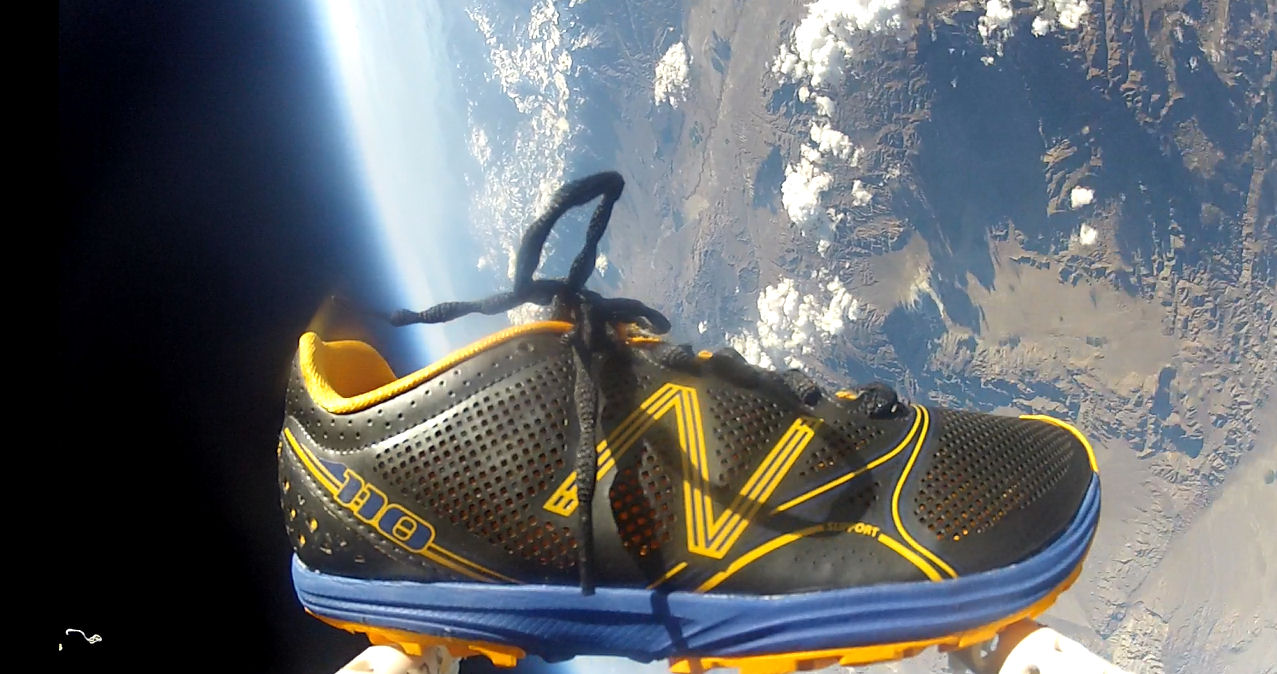
Just saw this on one of my favorite websites, spaceweather.com
Check out the running shoe!

ADVERTISE AT THE EDGE OF SPACE: Spaceweather.com is pleased to announce a unique advertising opportunity. We can launch your ad banner or product to the edge of space itself. Take a look at this running shoe or this bobble-head figure. In collaboration with Earth to Sky Calculus, a student-run corporation based in Bishop, California, Spaceweather.com will fly a helium research balloon to 120,000 feet where your ad, picture, birthday greeting or other item can be photographed against the limb of the Earth. Liftoff is scheduled for 9 am on April 22nd, Earth Day 2013! Contact Dr. Tony Phillips for pricing and details.                              

Thursday, March 14, 2013